




Reporting in 2026: what will change?
Reporting will continue to be called the same thing, but it will mean something completely different.

Reporting will change: less reporting, more steering
Reporting in 2026 is less and less about delivering reports and more and more about supporting decisions. CFOs and Financial Managers not only focus on profit and continuity. They also focus on data-driven choices, digitization and reliability of information.
At the same time, the amount of dashboards and standard reports is growing. Departments send loose overviews around, BI teams build dashboards, suppliers deliver standard reports. The result is recognizable: lots of numbers, little focus. The problem rarely lies in a lack of data, but in a lack of focus and a single language.
Faster insight will become the norm. MTs expect faster insight into deviations and trends. Those who only see that margin is running away at the end of the month are steering too late. So the question becomes: how do you make information available faster without finance drowning in manual labor?
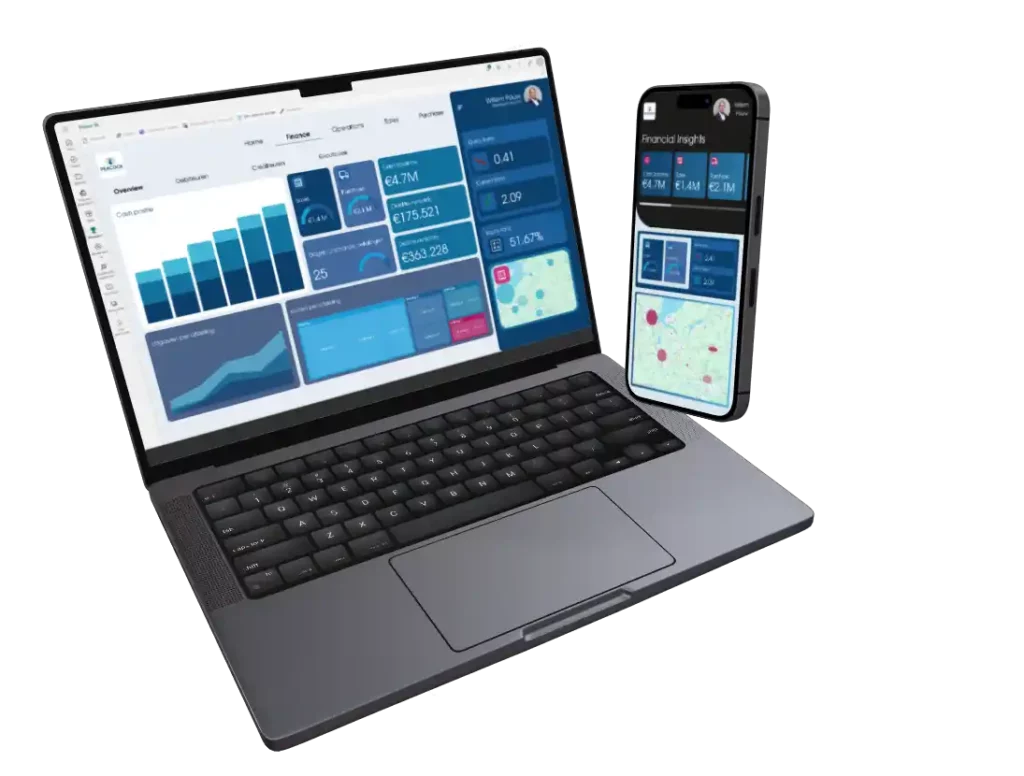
BI helps, provided you set it up right: a cockpit with fixed KPIs, clear definitions and data that runs automatically.
What not to do in 2026
The reflex is often: build another dashboard, add even more KPIs. That works for a while, but usually only makes reporting busier. You get more charts, more discussion and less guidance. The alternative is simpler: choose a small set of KPIs that recurs in every MT meeting and treat that as a fixed agenda. Anything outside of that remains analysis. That way your dashboard becomes a steering cockpit and not an archive. That's the difference between reporting and really steering.
One truth will be more important than even more dashboards.
In many organizations, multiple versions of the same KPI exist. Sales and finance calculate differently, or definitions differ by team. Then the MT starts discussing numbers instead of making decisions. Therefore, in 2026, "single source of truth" will no longer be a luxury, but a prerequisite.
In an article, Deloitte explains why this makes a difference for finance: without clear definitions and governance, reporting remains slow, expensive and error-prone.
KPIs will be the steering model, not the appendix
In 2026, steering increasingly works with a fixed MT agenda. Think of 10 to 15 KPIs that recur every month. The rest you only use as depth when necessary. It is precisely this limitation that makes it stronger: you force focus. And with focus you turn reporting back into real steering.
You can also see this development in tooling. Microsoft is making Power BI and Fabric smarter and smarter, with features that allow you to query your data faster. Copilot, for example, helps analyze reports and semantic models. Microsoft is also focusing more on reliable answers, with features such as Verified answers and better context, so that the same question does not always give a different answer.
At the same time, the convenience of automatically generated semantic models is disappearing in Fabric. That sounds technical, but the message is simple: organizations need to be more conscious about their data model and definitions. That fits exactly with reporting in 2026. First set the KPIs and definitions tightly, then accelerate with smart tooling.
AI and automation are coming, but not as a starting point
AI can signal deviations in margin, working capital or project returns. Automation takes repetitive work out of finance and operations. But without a fixed KPI set and unambiguous definitions, it mostly accelerates noise. Therefore, the order remains the same: first KPIs and definitions, then data, and only then automation. Then you get not only faster insight, but also reliability. And that is exactly what reporting in 2026 needs.
Happy New Year closure
Want to start 2026 with peace of mind, overview and faster decision-making? Then start with one question: which 10-15 KPIs do we want to see as standard in every MT meeting? Do you want to make this concrete? Also read Close 2025 faster than ever before through BI and From data chaos to instant answer to your question.
Whitepaper:
50 KPIs for better business
From separate reports to one steering cockpit. Includes 50 core KPIs and method to choose board KPIs.